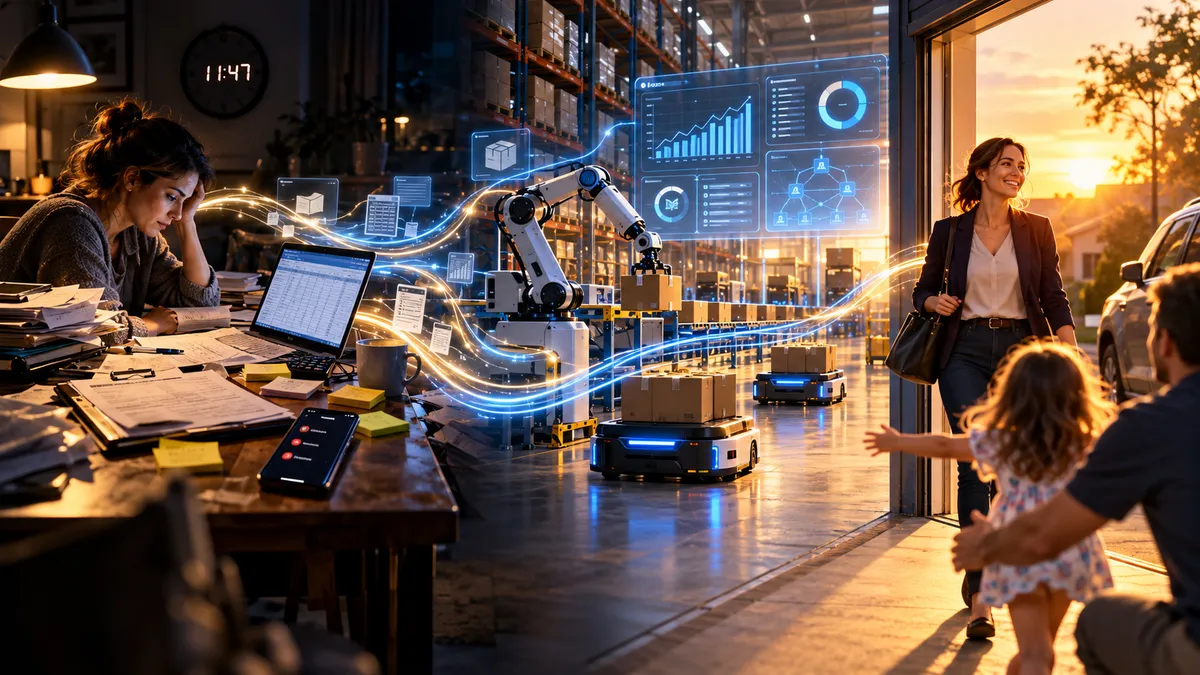
The Quiet Revolution: How Engineered Systems Give Us Back Our Time
11:47 p.m.
Maria runs a cleaning company with forty employees. It is almost midnight, and she is still at the kitchen table.
She is copying supply counts from a clipboard photo into a spreadsheet. She is cross-checking tomorrow's schedule against three group texts. She is returning a voicemail from a client who called at 4:15, while she was on a job site.
None of this is the work Maria started her company to do. She started it to build something. Somewhere along the way, the business started running her.
Millions of owners, managers, and operators live some version of this night. The good news: it does not have to stay this way. The technology to give Maria her evenings back already exists. The question is whether we build it with care.
The invisible tax on human potential
Every business pays a tax that never shows up on a balance sheet. It is the cost of work that should not need a person at all.
It looks like re-typing the same data into four tools. It looks like a follow-up that slipped because nobody owned it. It looks like a warehouse team hunting for a pallet that the system says is somewhere else.
That tax is paid in hours, but the real cost is human. It is the nurse buried in paperwork instead of with patients. It is the technician who never gets to fix the hard problem because the easy ones never stop. It is the founder who misses bedtime stories to reconcile invoices.
When we talk about technology making the world better, this is where it starts. Not with science fiction. With the 11:47 p.m. kitchen table.
One nervous system, three layers
Think of a business as a living body. For most companies, the organs work, but the nervous system is patched together with sticky notes and good intentions.
At Northven Technologies, we build that nervous system in three layers that work as one:
Custom software is the skeleton. Inventory systems, operations dashboards, client portals, and internal tools built around how a business actually runs. It gives every person one source of truth instead of five conflicting ones.
Artificial intelligence is the reflexes. Voice agents that answer, qualify, and book. Document systems that read, classify, and route. Decision layers that act on what they find, so the 4:15 p.m. call gets answered even when the owner is on a job site.
Robotics is the hands. Physical automation for warehouses, production floors, and service operations: moving, sorting, handling, and inspecting. Connected to the software, so the physical and digital sides of the operation finally agree.
Most firms sell one of these pieces. The magic happens when they are designed together. A robot that moves inventory is useful. A robot that moves inventory, updates the system, and triggers the reorder before anyone notices a shortage is transformative.
A day in the better world
Imagine the same week, one year from now.
Monday, 7:02 a.m. A warehouse supervisor opens one dashboard. Every pallet is where the system says it is. The night shift's counts updated themselves. She spends her morning training a new hire instead of chasing discrepancies.
Tuesday, 4:15 p.m. A client calls Maria's company. An AI voice agent answers on the first ring, understands the request, and books a walkthrough on Thursday. Maria sees it on her phone between jobs and smiles.
Wednesday, 2:30 p.m. A robotic cell handles the repetitive sorting on a production floor. The two people who used to do it now run quality control and suggest process improvements. Their jobs got more interesting, not smaller.
Thursday, 6:00 p.m. Maria closes her laptop. The schedule is set, supplies are reordered, and follow-ups are sent. She is home for dinner.
This is what a better world looks like up close. Not robots replacing people, but systems carrying the weight so people can do the work only people can do: creating, caring, deciding, and building.
Building it the right way
Powerful technology only makes the world better when it is built honestly. We hold ourselves to a few simple rules:
Automate the burden, not the humanity. We map how an operation really runs, then decide together what gets automated, what gets built, and what gets left alone. Sometimes the right answer is "not this part."
Tell the truth about fit. If robotics or AI is not the right answer for a problem, we say so in the first conversation.
You own what we build. Your data, your workflows, your logic, documented and handed over. We build systems a client could run without us, then earn the relationship by being worth keeping.
Security by default. Encryption in transit and at rest, role-based access, and audit logging on every system we deploy.
We stay on. Systems need care after launch. Monitoring, training, and iteration are part of the job, not an afterthought.
Trust is the real infrastructure of the future. Without it, even brilliant technology fails the people it was meant to serve.
The quiet revolution
The biggest changes rarely arrive with fanfare. Electricity did not announce itself; one day the lights were simply on. The next great shift will feel the same way. Fewer late nights. Fewer dropped balls. More time for the work and the people that matter.
That is the revolution we are building at Northven Technologies: engineered systems that quietly carry the load, so humans can get back to being human.
If your business still has an 11:47 p.m. kitchen table, let's talk. Book an appointment and we will walk through your operation, find where the friction really is, and tell you honestly what is worth automating.